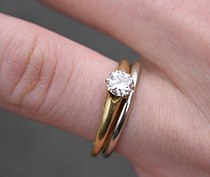
Jewelry Discount House lets you be the custom diamond ring designer. Select from a wide array of bridal sets in settings that range from elegantly simple solitaires to flamboyant mountings loaded with diamonds. You can choose from a huge inventory of diamonds in a wide variety of shapes including Round, Princess, Emerald, Radiant, Oval, Pear, Marquise, and Heart-shaped. Select the diamond's cut, clarity, color, and carat size to meet your exacting specifications and to fit your budgetary requirements. It's easy, we'll lead you though our design pathway to create THE diamond engagement ring that's uniquely her.
Tuesday, June 24, 2008
Diamond Engagement Rings
Jewelry Discount House lets you be the custom diamond ring designer. Select from a wide array of bridal sets in settings that range from elegantly simple solitaires to flamboyant mountings loaded with diamonds. You can choose from a huge inventory of diamonds in a wide variety of shapes including Round, Princess, Emerald, Radiant, Oval, Pear, Marquise, and Heart-shaped. Select the diamond's cut, clarity, color, and carat size to meet your exacting specifications and to fit your budgetary requirements. It's easy, we'll lead you though our design pathway to create THE diamond engagement ring that's uniquely her.
Wednesday, June 18, 2008
Wedding Bands / Wedding Rings (Women)
The Egyptians supposedly invented the concept of the wedding band 4,800 years ago, by twisting plants, such as hemp, into circles and putting the ring on the fourth finger in order to link a couple's destiny. Purportedly, the twisted floral circle represented unending love. Later on, the Romans used iron wedding bands to signify ownership. The husbands saw the bands as legal tokens reminiscent of a modern-day proof-of-purchase. Today, we like to blend the Romanticism of the Egyptians with the pragmatism of the Romans. The modern wedding band symbolizes eternal love, along with indicating that you "belong" to someone. Thankfully, mankind has replaced the twists of hemp and the heavy, corroding iron, with gold and diamonds. We at Jewelry Discount House, are pleased to offer you a wide selection of wedding bands, from the simple gold wedding band, to elaborate styles with unique engraving and design, smothered in diamonds. For those interested in the completely unique ring, may we suggest our diamond ring configurator, where you can create a ring for your own exacting specifications.
Wedding Bands / Wedding Rings (Men)
Although woman having been wearing wedding bands for thousands of years, the concept of a wedding band for men is relatively recent. During World War II, men began wearing wedding rings to remind them of their wives and as a symbol of their love and marriage. Starting out as a simple gold band, men's wedding rings have in recent years seen an explosion in style and material choices. Jewelry Discount House offers wedding bands for men in tungsten, titanium and palladium as well as yellow and white gold. Our modern rings can be of simple design or carved, engraved and encrusted with diamonds or other gemstones, all at a reasonable price.
Sunday, June 15, 2008
The most popular trends in engagement rings
Shape
Classic shapes, such as round and emerald-cut remain popular, but the oval and Asscher are also on the rise.
Metal
Gold has always been the traditional metal used for engagement rings; however, platinum has become the new metal of choice because of its rarity, durability, and rich luster. For brides who like the silvery look of platinum but want to avoid the high price tag, 18k white gold is a practical and more affordable option.
Settings
While the solitaire and three-stone settings are classic, many brides are turning to the bezel and tension settings for a modern, streamlined look. In a bezel setting, the stone is flush with the ring’s surface as opposed to sitting above the ring in prongs. This makes the stone appear larger than it would on a prong setting. In a tension setting, the diamond is held only on its edges so that it looks as if it is floating.
Colored
StonesAn engagement ring doesn’t have to include only diamonds. Rubies, emeralds, and sapphires can also be used to accent a diamond, or even be featured as the center rock. Another way to incorporate color is to choose a colored diamond, such as yellow or pink.
Antique
The vintage look means that what’s old is now new again. Elements include fine details, such as inset stones, carved scrolling, and filigree patterns. The classic Asscher, round, or cushion cuts are usually used, and are complemented by surrounding micro-pave diamonds.
Pave
Pave means that the band is encrusted with small diamonds set very close together. The effect is perfect for bringing out the beauty of the main stone.
Classic shapes, such as round and emerald-cut remain popular, but the oval and Asscher are also on the rise.
Metal
Gold has always been the traditional metal used for engagement rings; however, platinum has become the new metal of choice because of its rarity, durability, and rich luster. For brides who like the silvery look of platinum but want to avoid the high price tag, 18k white gold is a practical and more affordable option.
Settings
While the solitaire and three-stone settings are classic, many brides are turning to the bezel and tension settings for a modern, streamlined look. In a bezel setting, the stone is flush with the ring’s surface as opposed to sitting above the ring in prongs. This makes the stone appear larger than it would on a prong setting. In a tension setting, the diamond is held only on its edges so that it looks as if it is floating.
Colored
StonesAn engagement ring doesn’t have to include only diamonds. Rubies, emeralds, and sapphires can also be used to accent a diamond, or even be featured as the center rock. Another way to incorporate color is to choose a colored diamond, such as yellow or pink.
Antique
The vintage look means that what’s old is now new again. Elements include fine details, such as inset stones, carved scrolling, and filigree patterns. The classic Asscher, round, or cushion cuts are usually used, and are complemented by surrounding micro-pave diamonds.
Pave
Pave means that the band is encrusted with small diamonds set very close together. The effect is perfect for bringing out the beauty of the main stone.
Saturday, June 14, 2008
Materials
Most religious marital ceremonies accept a band of any material to symbolize the taking of marriage vows, with unusual substitutions permitted in marriages under unusual circumstances.To make wedding rings, jewellers most commonly use a precious yellow alloy of gold, hardened with copper, tin and bismuth. Platinum and white alloys of gold are also used, although the slightly yellow "white" gold alloys of the past have been largely replaced by a cheaper nickel-gold alloy, covered with a thin plating of rhodium which must be reapplied after some years of wear. Titanium has recently become a popular material for wedding bands, due to its durability, affordability, and gunmetal grey colour. Tungsten carbide, often with gold or platinum inlays, is recently being used as well. The least expensive material in common use is nickel silver for those who prefer its appearance or cost. Marrying couples are also beginning to use stainless steel, which has the same durability as platinum or titanium, and can accept a finer finish than the latter. Silver, copper, brass and other cheaper metals do not occur as frequently because they corrode over time and thus do not convey a sense of permanence. Aluminium is almost never used.
Price
The price for an engagement ring can vary considerably. Usually, they can be found within the range of a few hundred dollars to several hundred thousand dollars. Price varies by the material used, the value of the diamond, and retailer. A conventional buying price ranging from two to three months wages for a ring guideline originated from De Beers marketing materials in the early 20th century, in an effort to increase the sale of diamonds. [6][7]When shopping for rings with one or more diamonds, the price can depend significantly on the carat weight, color, clarity and cut of the diamond, otherwise known as gemological characteristics of the diamond.
Engagement ring
Engagement Ring History
The inception of the engagement ring itself can be tied to the Fourth Lateran Council presided over by Pope Innocent III in 1215 [1]. Innocent declared a longer waiting period between betrothal and marriage; plain rings of gold, silver or iron were used earliest. Gems were important and reassuring status symbols to the aristocracy. Laws were passed to preserve a visible division of social rank, ensuring only the privileged wore florid jewels. As time passed and laws relaxed, diamonds and other gems became available to the middle class.At one time, engagement rings mounted sets of stones. One traditional sentimental pattern mounted six to celebrate the joining of two families: The birthstones of the bride's parents and the bride (on the left), and the birth stones of the groom and his parents (on the right). The parents' stones were mounted with the mother to the left of the father. The bride and groom's birthstones would be adjacent in the center. Another similar pattern, for four stones, mounted the birthstone of the parents' marriages, and the birthstones of the bride and groom. These token rings often disassembled, to expose a channel in which a lock of the suitor's hair could be treasured.A Victorian tradition was the Regards ring, in which the initials of the precious gems used spelled out the word "regards". Another Victorian tradition was the Dearest Ring, which spelled the word "dearest" using the first letter of each jewel.The origin of our custom to use diamonds in rings, and more recently, in engagement rings, can be traced back to the Middle Ages and even the Romans. The Romans valued the diamond entirely on account of its supernatural powers. Pliny wrote that a diamond baffles poison, keeps off insanity and dispels vain fears. [2]. The medieval Italians copied these beliefs and added some to it: they called it the "Pietra della Reconciliazone" because it maintained concord between husband and wife. On this account it was recommended as the stone to be set in wedding (or espousal) rings. Note: not on account of its beauty therefore, which was described by Isidore of Seville as a small stone devoid of beauty. [2]In more recent times a Parisian Oracle of mystic subjects, the Baron d'Orchamps, announced the diamond, if worn on the left (hand) warded off evil influences and attracted good fortune and since he had fashionable clients the word spread and the wearing of the diamond on the left hand became in itself a fashion. [3]One of the first occurrences of the diamond engagement (or wedding) ring can be traced back to the marriage of Maximilian I (then Archduke of Austria) to Mary of Burgundy in 1477. [4] Other early examples of betrothal jewels incorporating diamonds include the Bridal Crown of Blanche (ca. 1370–80)[4] and the Heftlein brooch of Vienna (ca. 1430–40),[4] a pictorial piece depicting a wedding couple.The diamond engagement ring did not become the standard it is considered today until after an extensive marketing campaign by De Beers in the middle of the 20th century, which came to include one of the most famous advertising slogans of the 20th century: “A Diamond is Forever”.In the early 20th century, the United States jewellery industry attempted to start a trend of male engagement rings, going so far as to create a supposed "historical precedent" dating back to medieval times. The attempt failed, although the industry applied lessons learned from this venture in its more successful bid to encourage the use of male wedding rings. [5]
Subscribe to:
Comments (Atom)